Nebet Tepe- the Medieval fortress of Plovdiv
Back to all places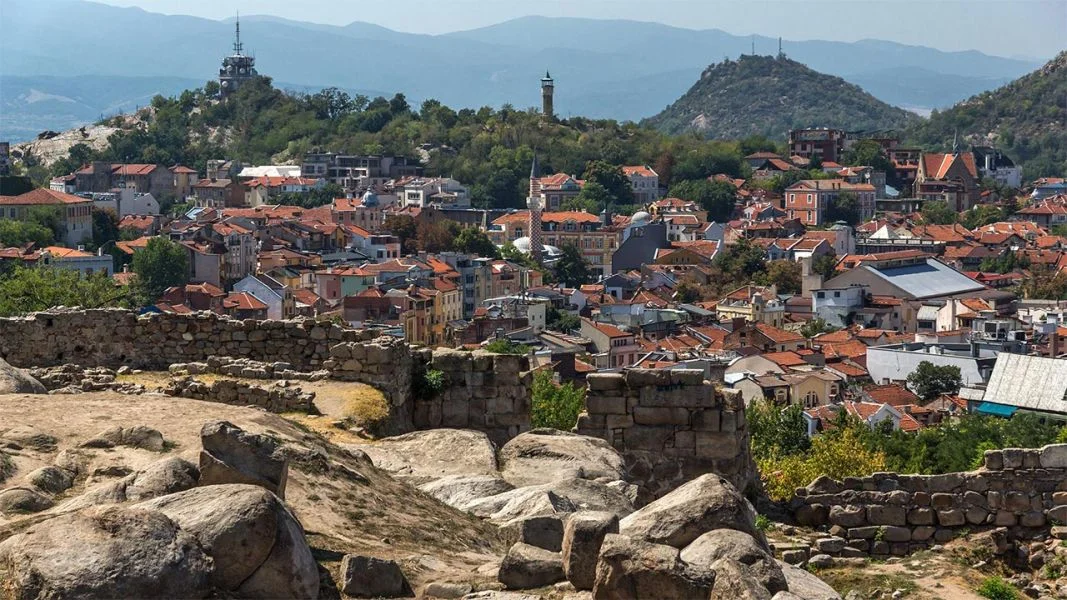
Climb the stone path to Nebet tepe, and you’re standing on the acropolis of ancient Philippopolis—the rocky heart that watched the city grow for millennia. Here, the first long-lived settlement took shape in prehistory and the Thracian era; later, as the town expanded down the slopes, this hill became the citadel that guarded the river crossing and the roads threading the plain. You can still read that story in the masonry around you: lines of wall, tower bases, and a hidden exit chiseled into the rock itself.
Face the surviving curtains of fortification. Their fabric spans centuries. Along the western flank are remains of a Hellenistic-period wall and a massive quadrangular tower—work from the age when the hilltop was formalized as the acropolis. Later builders thickened and repaired the defenses, and in Late Antiquity, under Justinian rule, engineers added a postern—a secret vaulted passage cut through the bedrock with steps—so that a garrison could slip down toward the Maritsa’s bank even during a siege.
Water made this summit livable. On the southern terrace, you’ll see the great rectangular cistern: its walls are built in alternating courses of stone and brick, the interior coated with a waterproof hydraulic plaster. Estimates put its capacity around 300–350 m³—a strategic reservoir for a hilltop garrison. Several smaller reservoirs and tanks once dotted the complex, but this is the showpiece, and parts of its inner lining are visible today.
After the Ottoman conquest in the late 14th century, Plovdiv (Filibe) sat safely inside the empire’s heartlands, so the acropolis lost much of its active military role. Civil structures started to appear, and in the 18th and 19th centuries, this hill was one of the neighborhoods of the Ottoman city. You can see some original photos from the early 20th century on some of the signs in the complex. In 1934, massive excavations started, and the old houses, most of them abandoned and neglected at the time, were removed, and the present-day park was born.
And as you stand among the stones, remember: this is one of Plovdiv’s most continuous addresses. Thracian, Macedonian, Roman, Byzantine, and medieval Bulgarian hands all worked these ramparts. That continuity is why Nebet Tepe remains a defining stop in the Old Town today—an outdoor textbook of city-making, opening onto the best panorama in Plovdiv.
42.15135, 24.75225