The Agora
Back to all places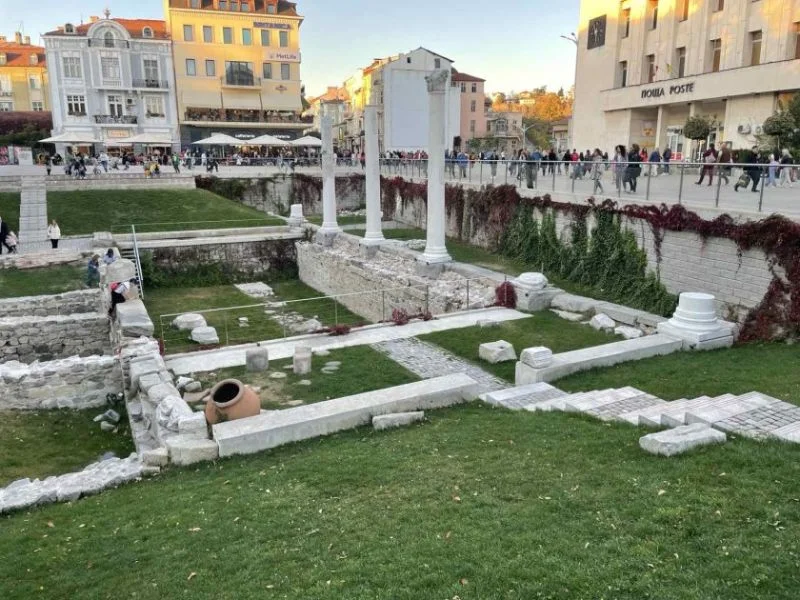
Stand in today’s square, and you’re standing on the civic heart of ancient Philippopolis. In the Hellenistic era (after the 4th c. BC), the town spread from the Three Hills onto the plain, with an orthogonal street grid and a Greek-style agora among its public buildings; Rome later retained that urban logic but rebuilt the center on a grander scale.
Under the emperors Vespasian and Hadrian, the city laid out a near-square Forum—about 143 × 136 m—paved and ringed with colonnades and shopfronts (tabernae). Monumental propylaea opened on the east, south, and west, tying the square into the cardo and decumanus streets just outside the eastern gate of the complex. Archaeology distinguishes four building phases: early sandstone/Doric porticoes, a marble upgrade, and finally a Corinthian colonnade on a syenite stylobate. The north side concentrated the city’s public institutions: the Odeon, which was a small music hall, and also was used as the Bouleuterion. This was the city council institution. This Hellenistic institution was respected by the Roman state in places where Roman rule was welcomed. The other institutions in this sector were the city library and an official treasury attested epigraphically. Finds here include statue bases, an exedra, which is a speaker’s platform, an altar to Demeter and Kore, and even part of a public notice for gladiatorial games—everyday evidence of civic, religious, and entertainment life clustered around the square.
Epigraphy from the Forum is vivid. In recent seasons, teams reported honorific and administrative inscriptions, including a 2nd-century Greek letter fragment likely tied to Septimius Severus’ reign—typical of the official texts that once stood on pedestals around the plaza.
42.14288, 24.74950