The Dzhumaya Mosque
Back to all places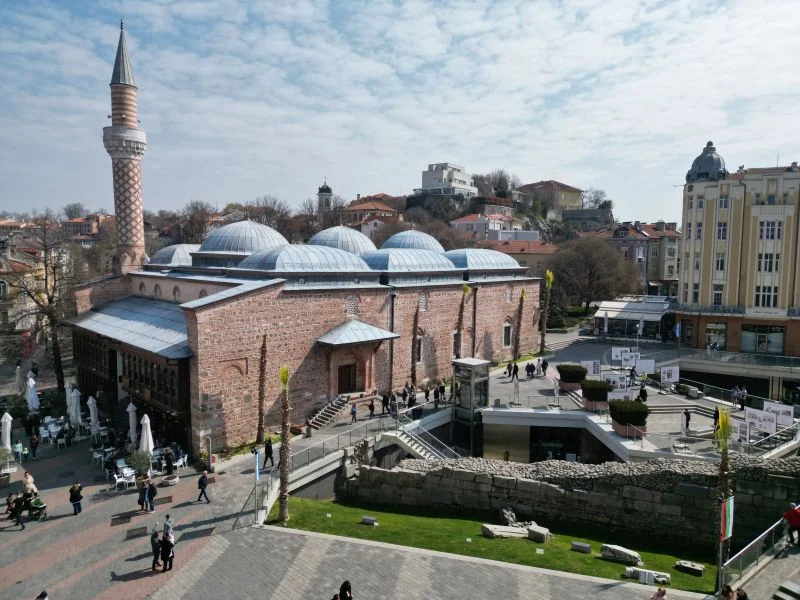
Here, the Ottoman city comes into focus. Dzhumaya, or Friday Mosque, marks the moment when medieval Philippopolis became Filibe in the rising Ottoman world. After the Ottomans seized Adrianople in the early 1360s and pushed steadily along Thrace under Murad I and his commander, Lala Şahin Pasha. Plovdiv fell in 1363–1364. On the site of the demolished cathedral of St Petka, the first Friday mosque was raised; in the mid-15th century, during Murad II’s reign, it was replaced by the larger, multi-domed building you see today—an early imperial-style congregational mosque announcing new authority at the city’s heart. Architecturally, Dzhumaya is a classic multi-domed Ottoman mosque: a broad rectangular prayer hall carried on arches, capped by nine lead-sheathed domes, with a tall minaret at the northeast corner. The masonry alternates stone and brick in bands—an Ottoman technique influenced by Byzantine building. Inside, painted ornament from the late 18th to early 19th centuries softens the scale. Step outside and you’ll notice how the mosque shares the square with the exposed curve of the Roman stadium’s sphendone—two empires in one glance.
An Ottoman Friday mosque was the anchor of a whole urban ecosystem. Around Dzhumaya grew Filibe’s commercial and charitable core: the Uzun Çarşı (“Long Bazaar”) and what we now call Kapana, packed with craft and trade. The traveler Evliya Çelebi tallied 880 shops here in the 17th century, along with heavy-duty market buildings like the bedesten (covered hall for precious goods), roadside hospitality in the Kurşum Han caravanserai, and public baths such as Chifte Hamam. Much of that fabric stood within a few minutes’ walk of the mosque.
Why is so little of that complex visible now? Three forces erased it. First, fires and earthquakes, especially the 1928 quake, damaged major Ottoman monuments. Second, early-20th-century modernization: the bedesten was demolished in 1920 during a new city plan, and the great Kurşum Han, badly hit in 1928, was finally pulled down in 1930–1932 to make way for the Central Market Hall—part of a municipal push for a modern covered market. Third, late-20th-century street widening and redevelopment finished the break between the mosque and its bazaar web. Today, the best survivor is Chifte Hamam, now used as a contemporary art space.
Dzhumaya is an active place of worship for Plovdiv’s Muslim community, open to visitors between prayers; dress modestly, remove shoes, and you can step into a calm, chandelier-lit hall beneath the nine domes. If you like Turkish sweats, coffee, black tea, or you would like to taste the rose water I highly recommend the cafeteria next to the entrance of the medieval temple.
42.14815, 24.74818