The East Gate
Back to all places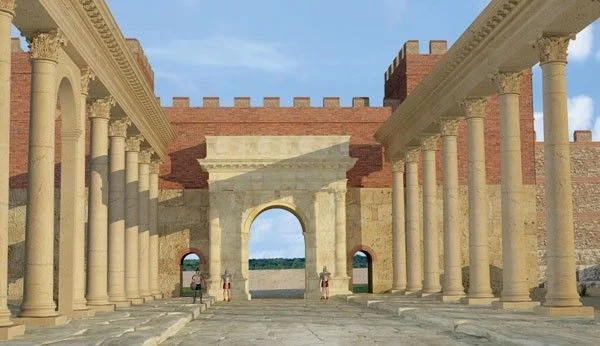
You’re standing at the city’s eastern threshold, where an ancient road once poured life into Philippopolis. In 46 AD, Rome annexed Thrace outright, and Philippopolis blossomed as a provincial center on the great via Diagonalis—the highway linking Byzantium, later Constantinople, with the interior. This is the actual road that you are looking at. In the early 2nd century, under Hadrian, a monumental three-arched gateway (a tripylon) was set up here to honor the emperor, probably due to his arrival in the city, and proclaim the entrance to the city from the east.
Till the time of Constantine, that honorific arch was literally built into the city’s defenses, built due to the turbulent times in the Roman world, known as The crisis of the 3rd century, and transformed into the principal East Gate. From it ran a lavish, colonnaded avenue: two-storey porticoes with Roman-Corinthian columns and shopfronts behind, the kind of grand, shaded street you’d expect in a proud provincial capital. The street’s axis leads you toward the heart of Late Antique Philippopolis—the Episcopal (Bishop’s) Basilica, which you can also explore on this map, tying the gate into the city’s sacred and civic geography. Along this same processional street lay the Eastern Thermae.
And the spot had a powerful Christian memory. Near the East Gate, tradition located the martyrdom of the “Thirty-Eight of Philippopolis,” and an early Christian martyrium rose to honor them—one of several late antique sanctuaries that dotted the city as it embraced the new faith.
What do you see today? You’re looking at the footprint of that transformation: foundations of the gate incorporated into the late Roman fortification line; stretches of the grand colonnaded street with column bases where two-level porticoes once stood; the clear eastward opening where the old highway entered the city, and the urban stage set that directed you toward the basilica’s precincts. Taken together, the remains spell out a choreography of arrival—procession from road to gate, from market street to monumental church. Just take a few minutes to imagine what it was like to enter that gate 1600 years ago.
If you choose to go down and walk on this antique vital artery, you can also look through the glass floor and see the remains of the Roman sewage system. You will also notice parts of a statue’s pedestal of Basiliscus. He is a very interesting and Late Antique figure. He was no local dignitary. He was Emperor Leo I’s top general, later a short-lived usurper, and the man whom Philippopolis thanked in a very public way after a Gothic scare in the late 5th century.
After the murder of the powerful general Aspar (471), Gothic forces under Theoderic Strabo threatened Thrace. Basiliscus led imperial troops that helped safeguard Philippopolis. In gratitude, the citizens set up a bronze statue of him at the East Gate—not on the traditional civic stage of the agora or even the theatre. The choice of place matters: it shows that by the late 400s the city’s ceremonial focus had shifted toward the Christianized eastern quarter around the martyrium and episcopal complex. We even have the text that identifies the statue. The Latin epigram hails him as “magister of cavalry and infantry, consul, patrician… and triumphator,” celebrating his victorious return and calling him “a glory to his Romans.” Local memory of Basiliscus also turns up in church art: a mosaic inscription in the Small Basilica is associated with his name—another hint that honor and commemoration were concentrated in the Christian East-Gate precinct rather than the old forum.
Ok, I think it is enough for this incredible archaeological sight, and I hope it wasn’t too much at the end. Let’s continue with your exploration.
42.14896, 24.75555