The history of the Bachkovo monastery
Back to all places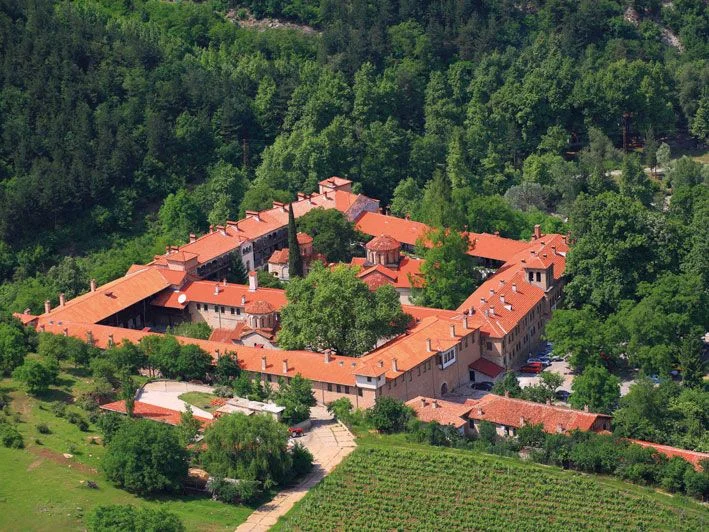
The Bachkovo Monastery, historically known as the Monastery of the Mother of God Petritzonitissa, was founded in December 1083 by the distinguished Byzantine military commander Grigorios Pakourianos, who served as the Grand Domestic of the West under Emperor Alexios I Komnenos. Born approximately in 1030 into the noble Bakurianis family of Georgian (Iverian) origin from the Tao-Klardzheti region, Grigorios rose to become the second most powerful figure in the Byzantine Empire after the Emperor himself. He established the monastery alongside his brother, Abasii (also known as Apasios), as a dynastic mausoleum and a spiritual bastion for Iverian soldiers; Abasii provided significant financial support but predeceased the completion of the complex and was the first to be interred in the ossuary. Grigorios himself was described by Anna Komnene as a man "tiny of body but a mighty warrior," meeting his end in 1086 during the Battle of Beliatoba against the Pechenegs when he reportedly crashed into a tree during a vigorous charge. The family’s imperial influence extended to the next generation; Grigorios’s grandson, Gregory Pakourianos the Younger, served as a provincial governor near Ohrid and married a daughter of Nikephoros Komnenos, the Emperor’s youngest brother, further cementing the Bakurianis lineage within the Byzantine aristocracy.
The institutional foundation of the monastery was codified in the Typikon of 1083, a set of monastic by-laws drafted by Grigorios and modeled after the Panagios monastery in Constantinople. Written in three languages—Greek, Georgian, and Armenian—the Typikon was a radical document for its time, incorporating philosophical views that challenged conventional Byzantine attitudes, such as the assertion that "slavery is a violent intrusion of tribal law into our lives." To ensure the monastery’s autonomy, Pakourianos secured stavropegial status and a royal decree from Alexios I, signed by Jerusalem Patriarch Euthymius, which granted the monastery complete independence from the Greek-dominated Bishopric of Plovdiv and total tax exemption. The Typikon was exceptionally strict regarding ethnicity; the 24th Chapter explicitly forbade the acceptance of Greek monks into the fraternity of fifty to prevent the potential annexation of monastic properties by Greek ecclesiastical authorities. Beyond liturgical rules, it mandated the establishment of a seminary for youth where religion, mathematics, history, and music were taught, with notable scholars like the philosopher Ioane Petritsi later contributing to its intellectual legacy.
Following the Comnena era, the monastery served as a cultural bridge until the end of the 12th century, when its exclusively Georgian character began to absorb Bulgarian influences. Another challenge was its existence in the Crusaders’ Latin empire between 1204 and 1261. In 1344, during the Byzantine civil war, the region was ceded to the Bulgarian Tsar Ivan Alexander in exchange for his military support. The Tsar became a significant patron and "co-founder," providing extensive donations recorded in a donor portrait in the narthex of the 11th-century ossuary. This golden age was also marked by the arrival of the Miraculous Icon of the Virgin Mary Eleusa in 1311, gifted by two Georgian travelers, Atanasii and Okropir. This interesting relic can be seen inside the main church. You will recognize it by the silver cover. However, the 1393 Ottoman conquest brought severe adversity; the monastery became the place of exile for the last medieval Bulgarian Patriarch, Saint Euthymius of Tarnovo. Euthymius continued his literary and orthographic reforms here, effectively turning Bachkovo into the final sanctuary for the Tarnovo Literary School before his death in the early 15th century.
41.94219, 24.84994