The history of the Fortress
Back to all places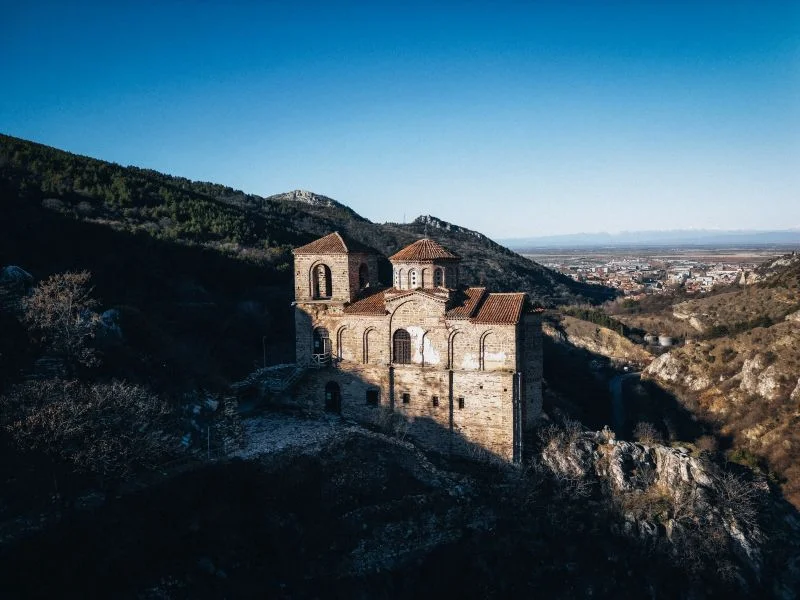
Welcome to the edge of the Rhodopes. As you look out over the vertical cliffs and the winding Asenitsa River below, you are looking at one of the oldest strategic corridors in Europe. This is not just a ruin; it is a checkpoint that controlled the pulse of history for over two millennia.
The story begins long before castles were built of stone. The Thracians were the first to realize that this sheer rock was a natural shield, fortifying it as early as the 5th century BC. This was the period when the Thracians of the Odrysian kingdom became involved in the expansion of the Persian Empire in the Balkans, the Greco-Persian wars, and the rise of the Athenian Empire.
It was the Romans who truly understood its value. They paved the ’Central Trans-Rhodopean Road’ that snakes through the valley below, linking the Danube to the Aegean Sea. Roman engineers carved switchbacks into these mountains and built stone bridges, some of which still stand near the village of Orehovo. The fortress you are standing in was the toll booth and the watchtower for this highway. You can actually see and walk on the remains of the road on your right.
To protect this vital artery from barbarian raids, Emperor Justinian I built the first massive walls here in the 6th century AD. The first written reference to the fortress appears in the 1083 statute of the nearby Bachkovo Monastery. The Byzantine commander Gregory Bakuriani, who founded the monastery, bequeathed the "Petrich Citadel" to it, marking a period where the fortress functioned as an administrative and agricultural center.
Yet, the most dramatic chapter of this fortress was written not by Romans, but by the clash between Bulgarian Tsars, Catholic Popes, and Crusader Knights.
To understand the violence that took place here in the 13th century, we must look to the diplomatic games played by the Bulgarian ruler Tsar Kaloyan. In the early 1200s, Bulgaria was a rising power seeking recognition after overthrowing the Byzantine dominance in 1186. Kaloyan, a brilliant tactician and strategist, reached out to Pope Innocent III in Rome. He offered to bring the Bulgarian Church under the authority of the Vatican in exchange for a royal title.
In 1204, a historic Union was signed. A cardinal was sent from Rome to crown Kaloyan, granting him the title of ’King,’ though Kaloyan proudly styled himself ’Emperor.’ It was a masterstroke designed to protect Bulgaria from its Catholic neighbors. But in that same year, the Fourth Crusade went rogue. Instead of marching to Jerusalem, the Crusaders sacked Constantinople, destroyed the Byzantine Empire, and established the Latin Empire. They ignored the Pope’s protection of Bulgaria and claimed Kaloyan’s lands for themselves. War was inevitable.
The tension exploded on April 14, 1205, at the Battle of Adrianople. There, Tsar Kaloyan’s forces, aided by Cuman light cavalry, annihilated the Crusader army. They captured the Latin Emperor Baldwin I, shattering the myth of Western invincibility.
In the chaos that followed, Renier of Trit, the Latin Duke of Philippopolis, found himself trapped. His city rose up against him, and he fled south, seeking refuge right here, in this fortress—then known as Stanimaka.
Imagine the scene: Renier barricaded himself inside these walls with only 40 knights. Below them, the entire Bulgarian army swarmed the valley. For 13 months, this tiny garrison held out. They were cut off from the world, surviving only because of the massive rock-cut cisterns that harvested rainwater. It became a legendary standoff—the ’Iron Knights’ on the rock against the ’Roman-Slayer’ Kaloyan. They were only saved in the summer of 1206 when a relief army led by the new Latin Emperor, Henry of Flanders, finally broke through the mountains.
Tsar Kaloyan died in 1207, leaving a power vacuum. His nephew, Boril, usurped the throne, but he lacked his uncle’s genius. The tide of war turned. In 1208, at the Battle of Philippopolis, just north of here, the Latin heavy cavalry smashed Boril’s army. For the next decade, this region remained a contested borderland, and the fortress likely fell under the influence of Latin vassals or independent separatists like Alexius Slav.
It wasn’t until 1218 that legitimate order was restored. Ivan Asen II, the rightful heir, returned from exile to depose Boril. Under Ivan Asen II, Bulgaria reached its zenith, stretching to three seas. In 1231, perceiving the lingering threat from the Latins to the south, he ordered the massive expansion of this site, building the fortifications whose ruins you see today. It was this renovation that gave the fortress its enduring name: The Asen’s fortress.
41.98637, 24.87300