The House of Nedkovich
Back to all places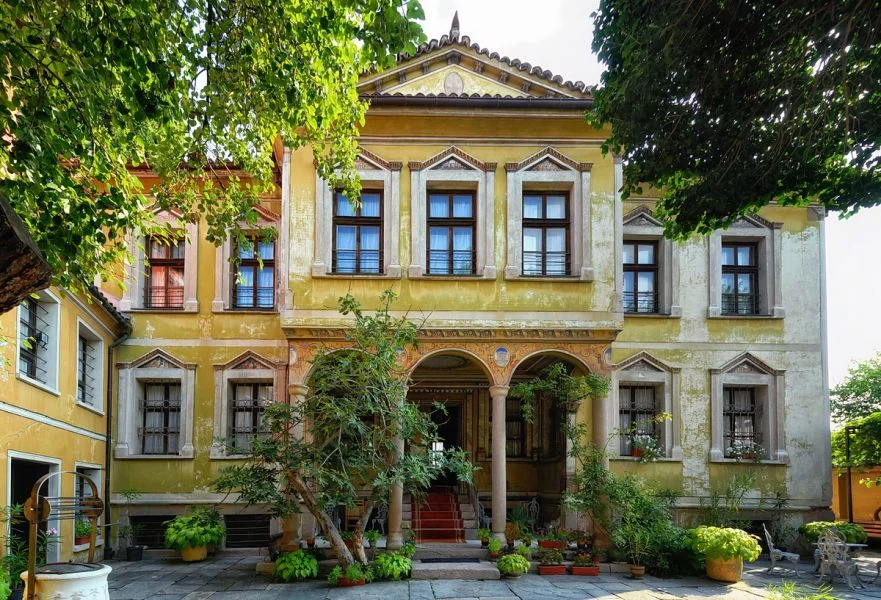
Welcome to Plovdiv’s Old Town — a place where time seems to fold in on itself. Cobblestone streets curve around ornate facades, and every building whispers stories from centuries past. And here, in the heart of it all, you’ve arrived at one of the city’s most expressive homes — the House of Nikola Nedkovich. But this is not just a house. It’s a mirror of an entire era — Bulgaria’s National Revival — a time of reawakening, pride, ambition, and bloody revolution.
Let’s step back into the 19th century. At that time, the Bulgarian lands were still under Ottoman rule. This period was marked by cultural flourishing, the birth of modern education, the fight for church independence, and a growing desire for national self-determination. It was triggered in the 18th century by the European Age of Enlightenment, but it evolved in the 19th century when the Ottoman Empire changed its diplomatic and economic relations with the Western powers. This gave a lot of opportunities to merchants, teachers, artisans, and writers, many from rising urban classes who began to travel, study abroad, and bring new ideas home. European taste, Enlightenment ideals, and local pride mixed into a uniquely Bulgarian rebirth. It is in this powerful current that the story of the Nedkovich family unfolds. Go now. If it is open, step into the yard of this beautiful house.
Nikola Nedkovich came from a wealthy merchant family in Karlovo — a city nestled at the foot of the Balkan Mountains. His family, originally known as Nedkov, had strong business roots and even family ties to the illustrious Georgiev brothers, Evlogi and Hristo.
In 1863, young Nikola was sent to Plovdiv to apprentice under his uncle and grow the family business. He soon emerged as a successful textile trader, building commercial ties with Edirne, Constantinople, and even Western Europe.
But his life was touched by tragedy. In 1876, during the buildup to the April Uprising against Ottoman rule, his father was killed by Ottoman forces. As a symbolic act of grief and resistance, Nikola changed his surname from Nedkov to Nedkovich, giving it a Slavic ending — a subtle but clear statement of anti-Ottoman and pro-Russian identity.
A patriot at heart, Nikola became active in the movement for an independent Bulgarian church, and after liberation, served as a municipal council member in Plovdiv and on the commission for the resettlement of Turks from the city.
He married Hariklia, a woman from a prominent Samokov family. Together, they had one surviving child — a daughter named Elena — who would inherit the house. A well-educated woman, Elena completed her studies at the Plovdiv Girls’ Gymnasium, a rare accomplishment for women of the time.
Nikola passed away in the early 20th century. His daughter Elena continued to live in the house until her death in 1958 at the age of 82. As she had no children, she bequeathed the house to her loyal housekeeper, Lyuba, who lived here until 1964. Then, the state acquired the property and converted it into a museum.
While many homes of this era have lost their original furniture, the Nedkovich House preserves at least a small portion of its authentic interior — a rare treasure in Old Plovdiv.
The house, built in 1863, follows the Plovdiv symmetric style of the Revival period, yet with distinct flourishes that make it stand out.
The main residence is two stories high, complemented by a service wing that once housed the kitchen, baths, and servants’ quarters. The two buildings are connected by a hidden underground corridor, allowing the staff to move discreetly and comfortably, even in poor weather. There’s even a tunnel leading directly to the main street, used for bringing in supplies or food without crossing the courtyard — a clever detail from a time long before modern logistics.
The facade is rich in symbolism and European influence. You’ll notice a four-columned portico with rounded arches, and above each window, painted medallions — small narrative scenes full of color and symbolism.
Perhaps the most unusual features are two images tucked into the lower left corner of the facade. One depicts a tied-up lion, symbolizing unliberated Bulgaria. The other? A tied bear. Why? According to tradition, when negotiating the construction, the master builder asked: “Should I paint the bear free or tied?” A free bear meant lower cost but no warranty. A tied bear meant the builder promised full quality — and accountability. Nikola, of course, chose the tied bear.
This small image tells us a lot about the man who lived here.
Now, if you want to see this treasure from the inside, take a ticket and get a deeper understanding of the time and the culture of the people who once lived here. I highly recommend that you ask the curator of the house to give you a guided visit of the inner part of the house. Before you leave, take one last look at the facade — the painted lion, the tied bear, the key that still opens the original wooden gate. This is more than a house. It’s a time capsule. A place where Revival-era Bulgaria still lives, breathes, and whispers stories.
42.14962, 24.75396