The Odeon
Back to all places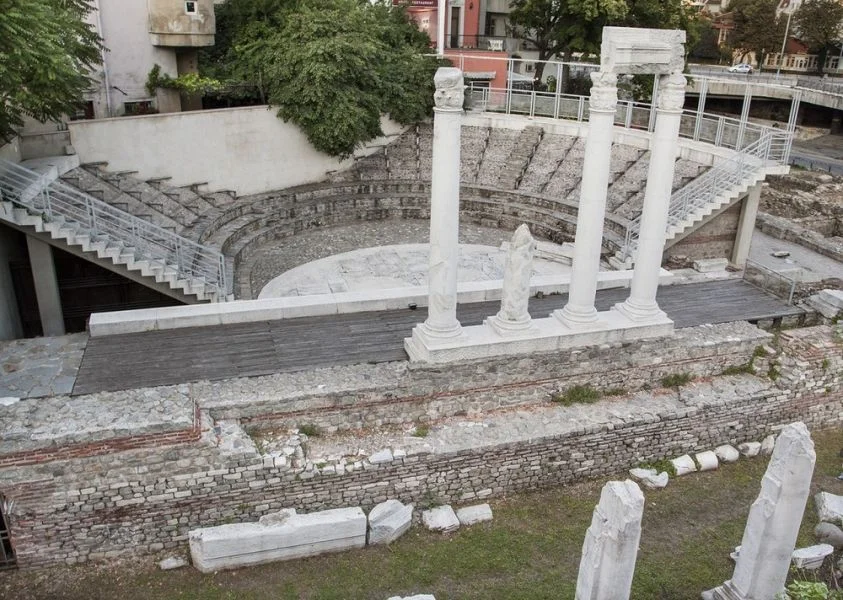
Walk to the northeast corner of Philippopolis’ Forum, and you step into its Odeon—the city’s roofed council house (bouleuterion) that doubled as a small theatre. Built in the 2nd century AD (Hadrianic age) and remodeled through four construction phases until the 4th century, it shows how politics, performance, and prestige met at the city’s core.
Architecturally, it’s a compact theatre: a two-storey skēnē in Corinthian style ran the full width of the cavea; grooves in the back wall suggest a lifting curtain mechanism. The orchestra began as a horseshoe (typical in the provinces) and, in the last phase, was tightened to a semicircle with a marble floor and orthostates. The cavea (auditorium) wrapped the east side and seated about 300–350 on vaults and radiating stairs—enough for the city council and invited publics. Parodoi separated the stage and seating, and galleries with staircases ringed three sides.
History left marks here. Around the Odeon, archaeologists have traced mid-3rd-century destruction tied to the Gothic raid of 250/251, after which the building continued in use until Late Antiquity.
42.14383, 24.75030