The Roman Stadium
Back to all places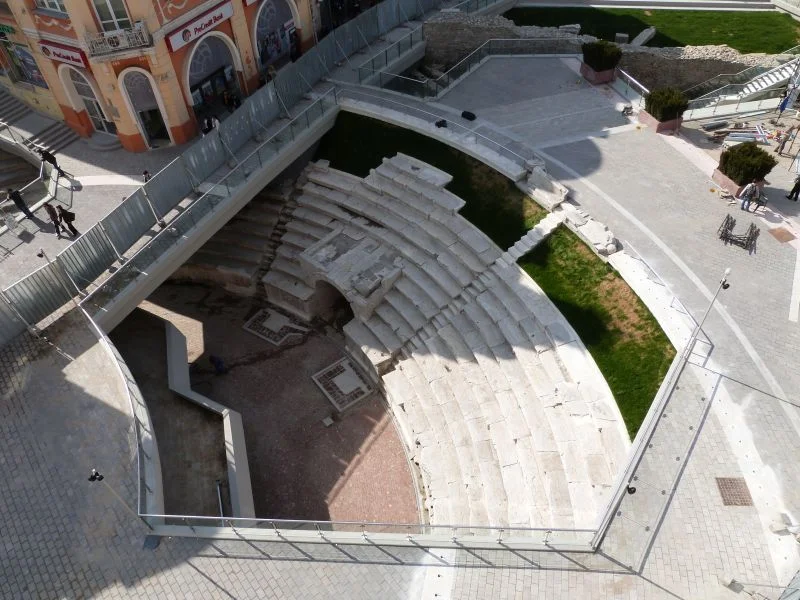
The Ancient Stadium of Philippopolis, constructed in the 2nd century AD during the reign of Emperor Hadrian, stands as one of the most remarkable and best-preserved public structures of the Roman era. Modeled after the prestigious stadium at Delphi, this colossal facility was strategically built into a natural depression between the slopes of Sahat Tepe (Danov Hill) and Taxim Tepe. Measuring approximately 240 meters long and 50 meters wide, it was designed to accommodate up to 30,000 spectators, reflecting the city’s status as a major metropolitan center of the province of Thrace.
Architecturally, the stadium was defined by its tiered marble seating, which consisted of 14 rows of marble benches often decorated with stylized lion’s paws. The northern end featured a horseshoe-shaped curve known as the sfendona, which housed a central vaulted entrance supported by a barrel vault to allow competitors access to the track. Positioned directly above this arched entrance was the tribunal, a special loggia reserved for the emperor and provincial governors to preside over the festivities. While the northern end provided functional access, the southern side was marked by a monumental façade that served as an architectural tribute to the city’s values. This façade was adorned with five marble pilasters featuring intricate reliefs of the insignia of Heracles—including his club and the skin of the Nemean lion—and the insignia of Hermes, represented by a herm, an amphora, and palm branches.
These symbols reinforced the stadium’s purpose as a venue for elite athletic competitions, such as the Pythian, Alexandrian, and Kendrisian games, which were organized by the General Assembly of Thrace (Koinon). Beyond these athletic contests, the stadium was usually used for chariot racing, a fact reflected in the 11th-century description by Anna Comnena, who referred to the massive ruins as a "huge hippodrome".
The stadium’s role within the city evolved in 172 AD under Emperor Marcus Aurelius, when a new fortification wall was unusually extended to encompass the structure within the city’s defenses. It remained a central hub of civic life even during times of crisis. In 250 AD, as the city faced a massive Gothic invasion led by their ruler Kniva, the Emperor Trajan Decius sent an official letter to the citizens. This letter was read aloud to the populace gathered on the stadium’s racing track, strictly instructing them to "hold fast" and remain behind the city’s defensive walls rather than engaging the Goths in open warfare before his professional relief force could arrive. Unfortunately, the reinforcements were not enough, and the city was taken and sacked by the Goths.
Despite its historical significance, the stadium began to decline at the end of the 4th century following Theodosius I’s ban on pagan Olympic games in 393 AD. Although abandoned for centuries, the ruins remained so impressive that they continued to be a landmark into the Middle Ages. Today, while much of the stadium remains beneath Plovdiv’s modern pedestrian street, the partially restored northern sfendona is visible at Dzhumayata Square, offering a window into the monumental scale of ancient Philippopolis.
42.14768, 24.74816