The Roman Theatre
Back to all places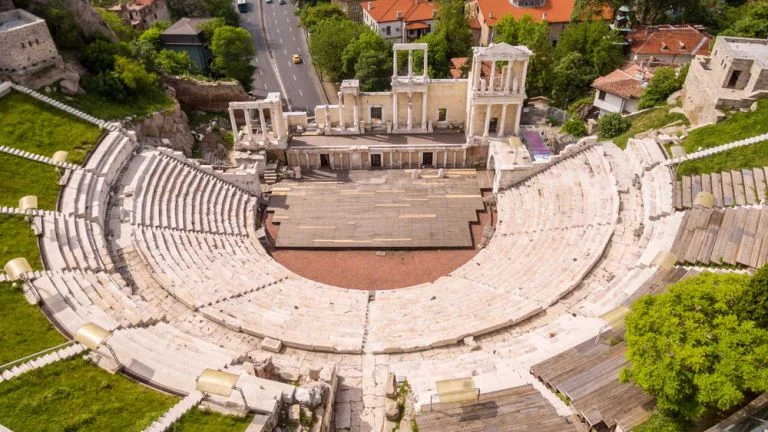
As you walk into the open semicircle of Plovdiv’s Roman Theatre, take a moment. Let your eyes travel across the marble seats, the arched stage wall, the hills in the distance. For nearly two millennia, this space has watched empires rise and fall, crowds roar and fall silent. You are standing inside one of the best-preserved ancient theatres in the world — and without a doubt, the most iconic monument of Roman Plovdiv.
The theatre was built in the late 1st century AD, during the reign of Emperor Domitian (81–96 AD). At that time, Philippopolis was a thriving Roman provincial center, the capital of the Roman province Thracia, and a city of strategic and cultural importance.
Between 5,000 and 7,000 citizens of Philippopolis gathered here to watch theatrical performances in Latin and Greek, official imperial ceremonies, and yes, gladiatorial games, wild beast hunts, and even public punishments. The very word gladiator still crackles with danger and drama. But contrary to popular myth, not all fighters in the arena were the same.
Some were professional gladiators — trained in special schools, highly skilled, and often volunteers. These men fought not just for money, but fame, and sometimes even freedom. They had contracts, trainers, fans, and were admired much like modern athletes. Even their weapons were special, designed to inflict serious wounds but not necessarily to kill. These people were very expensive investments, and no one wants to lose them in a day.
Others were condemned criminals, prisoners of war, or slaves, forced into combat. For them, the arena was often a death sentence — a brutal spectacle for the pleasure of the crowd.
In Philippopolis, both types of fighters likely entered this theatre, cheered on by citizens hungry for the drama of life and death. These games weren’t daily events, but they left unforgettable impressions when they happened, especially during festivals or in honor of visiting governors.
During the theatre’s rediscovery in the 1970s, archaeologists uncovered over 40 inscriptions, etched in marble and limestone — names of city magistrates, benefactors, and imperial officials. Many inscriptions are in Greek, showing how Philippopolis preserved its Hellenistic heritage even under Roman rule.
One inscription in particular records the name of the governor of Thrace under Emperor Domitian — helping date the theatre with remarkable accuracy.
There are also seating inscriptions, carved directly into the stone benches, reserving spots for city councillors and high-ranking citizens. Most of the names are Thracian names, written with Greek letters. This should not surprise you, as the Odrysian kingdom was considered a friend of Rome by the Senate, and it kept its elite and cultural dominance. No story of Roman arenas is complete without mentioning Spartacus — the most famous gladiator in history.
Spartacus was a Thracian, born in the western Rhodope region, near modern-day Sandanski, and a member of the Medi tribe, one of the many groups of the Thracian world. He was likely once a soldier, captured by the Romans and trained as a gladiator.
In 73 BC, Spartacus led a massive slave rebellion in Italy, known as the Third Servile War. With nothing except his exceptional strategic capabilities and the courage of men who had nothing to lose, he defeated several Roman legions and terrified the Republic. His uprising would be crushed, but his legend would live forever as a symbol of freedom and bravery.
As you sit on the stone benches of Philippopolis’s theatre, imagine Spartacus — a Thracian like many who once watched or fought in such arenas— turning his sword not on another slave, but on Rome itself.
For centuries, the theatre lay buried. Collapsed by an earthquake in Late Antiquity and was slowly forgotten. But in the 1970s, Bulgarian archaeologists revealed it, piece by piece, in one of the most extraordinary excavations in the Balkans.
Today, it lives again — not with lions and blades, but with concerts, operas, and plays under the stars. Ancient architecture now hosts modern voices. It’s a perfect circle of continuity — performance reborn where performance once ruled.
So as you stand here, know this: you are not just visiting ruins. You are entering a living monument, where emperors once ruled, gladiators bled, and poets still echo.
42.14717, 24.75137